'%3e%3cpath%20d='M150.127%20195.325C233.04%20195.325%20300.255%20168.696%20300.255%20135.848C300.255%20103%20233.04%2076.3709%20150.127%2076.3709C67.2143%2076.3709%200%20103%200%20135.848C0%20168.696%2067.2143%20195.325%20150.127%20195.325Z'%20fill='white'/%3e%3cpath%20d='M231.093%20118.256L150.117%20-0.000183105L69.1527%20118.256C68.1365%20119.748%2067.5967%20121.294%2067.5967%20122.871C67.5967%20136.017%20104.538%20146.666%20150.117%20146.666C195.697%20146.666%20232.638%20136.007%20232.638%20122.871C232.638%20121.294%20232.098%20119.748%20231.082%20118.256H231.093Z'%20fill='%2301A9F2'/%3e%3cpath%20d='M150.106%20356.844L98.7265%20281.5L62.3035%20311.117L25.4253%20257.017L50.787%20239.721L68.8556%20266.226L105.279%20236.62L150.106%20302.363L194.934%20236.62L231.357%20266.226L270.045%20209.48L295.407%20226.776L237.898%20311.117L201.475%20281.5L150.106%20356.844Z'%20fill='white'/%3e%3cpath%20d='M592.168%20165.22V237.908H561.482V171.825C561.482%20153.884%20551.807%20143.034%20535.051%20143.034C516.644%20143.034%20505.318%20156.011%20505.318%20175.604V237.908H474.875V171.349C474.875%20153.407%20464.968%20142.791%20448.445%20142.791C429.804%20142.791%20418.711%20156.011%20418.711%20176.07V237.908H388.025V118.964H418.711V134.301C426.502%20122.033%20440.421%20115.418%20458.13%20115.418C477.014%20115.418%20490.7%20122.975%20498.247%20135.953C506.747%20123.208%20521.608%20115.418%20540.725%20115.418C572.819%20115.418%20592.179%20135.476%20592.179%20165.22H592.168Z'%20fill='white'/%3e%3cpath%20d='M899.48%2080.2534C899.48%2068.2182%20909.388%2059.4856%20920.248%2059.4856C931.574%2059.4856%20941.248%2068.9274%20941.248%2080.2534C941.248%2091.3465%20931.574%20100.788%20920.248%20100.788C909.155%20100.788%20899.48%2092.0557%20899.48%2080.2534Z'%20fill='white'/%3e%3cpath%20d='M935.832%20118.955H905.146V237.899H935.832V118.955Z'%20fill='white'/%3e%3cpath%20d='M1140.2%20118.955H1173L1099.84%20288.644H1067.5L1090.6%20237.666L1043.42%20118.955H1076.45L1107.37%20204.81L1140.18%20118.955H1140.2Z'%20fill='white'/%3e%3cpath%20d='M883.182%20115.418H815.904C781.45%20115.418%20755.008%20137.837%20755.008%20171.825C755.008%20206.756%20778.846%20228.466%20815.904%20228.466C831.951%20228.699%20847.288%20231.059%20847.288%20246.64C847.288%20259.617%20835.962%20267.175%20817.555%20267.175C799.148%20267.175%20784.985%20254.664%20781.915%20239.326L756.66%20246.873C763.741%20274.722%20787.346%20292.188%20817.312%20292.188C856.963%20292.188%20876.313%20272.838%20876.313%20249.233C876.313%20234.605%20869.231%20223.036%20855.545%20215.721C868.522%20206.047%20877.022%20190.709%20877.022%20171.825C877.022%20160.986%20871.412%20149.3%20863.145%20140.674H883.182V115.418ZM815.904%20203.919C797.264%20203.919%20782.392%20192.117%20782.392%20171.825C782.392%20151.534%20799.148%20139.964%20815.904%20139.964C832.66%20139.964%20849.416%20151.29%20849.416%20171.825C849.416%20188.814%20835.497%20203.919%20815.904%20203.919Z'%20fill='white'/%3e%3cpath%20d='M737.426%20237.906V118.962H708.158V136.088C698.685%20121.481%20682.796%20115.426%20668.983%20115.426C633.587%20115.426%20608.087%20143.509%20608.087%20179.148C608.087%20214.788%20633.1%20241.452%20668.03%20241.452C682.426%20241.452%20698.24%20235.08%20708.148%20220.917V237.906H737.415H737.426ZM673.471%20213.835C653.645%20213.835%20638.308%20199.207%20638.308%20178.429C638.308%20157.65%20653.889%20143.032%20673.704%20143.032C694.705%20143.032%20709.1%20160.021%20709.1%20178.429C709.1%20196.836%20694.472%20213.835%20673.46%20213.835H673.471Z'%20fill='white'/%3e%3cpath%20d='M1003.29%20111.085C1003.29%2098.5315%201011.17%2091.8842%201023.98%2091.8842C1028.9%2091.8842%201033.83%2092.6251%201037.77%2093.853L1042.2%2068.0043C1038.02%2066.7765%201027.43%2064.7971%201021.27%2064.7971C994.18%2064.7971%20972.607%2081.786%20972.607%20110.355V118.961H956.889V144.216H972.607V164.519V237.915H1003.29V144.216H1038.46V118.961H1003.29V111.096V111.085Z'%20fill='white'/%3e%3c/g%3e%3cdefs%3e%3cclipPath%20id='clip0_1_3'%3e%3crect%20width='1173'%20height='356.842'%20fill='white'/%3e%3c/clipPath%3e%3c/defs%3e%3c/svg%3e)

UA Campaign
Overview
The UA Campaign section is designed for managing advertising campaigns imported into the system from MMP grabbers such as Adjust and AppsFlyer.
UA Campaign acts as a configuration and normalization layer between raw MMP data and the system’s analytical reports.
The UA Campaign list is available in:
Magify > Configuration > UA Configurations > UA Campaign
In this section, you can:
- review imported campaigns;
- configure and validate key campaign parameters;
- ensure correct campaign participation in analytics and reports.
Proper configuration of UA Campaign directly affects:
- accuracy of spend and revenue attribution;
- correct aggregation by traffic sources and ad networks;
- data consistency across all analytical reports.
Role of UA Campaign in Analytics
Each campaign in the UA Campaign section represents a link between MMP data and all analytical layers of the system, including:
- performance reports;
- ad network and traffic source analytics;
- aggregated analytical reports.
If key campaign parameters (especially Type) are missing or incorrect, the campaign may:
- be partially excluded from analytics;
- be excluded from certain analytical reports.
Data Synchronization
Campaigns are imported from MMPs automatically.
- Campaign names, Media Source, and technical identifiers are received directly from the MMP.
- Data synchronization runs automatically.
- Fields received from the MMP must not be edited manually unless explicitly allowed.
In the campaign details view, it is visually indicated which fields are editable and which are locked.
Main Fields
Application
The application to which the campaign belongs.
- Automatically filled during MMP import.
- Not editable manually.
- Always matches the data received from Adjust or AppsFlyer.
Used to ensure correct aggregation of analytics by application.
Name
The campaign name imported from the MMP.
- Used to identify campaigns in analytics and reports.
- Changes made to the campaign name in the MMP are not synchronized automatically.
Media Source
The traffic source as defined by the MMP (Adjust or AppsFlyer).
- Imported automatically if provided by the MMP.
- Not editable if the value was received from the MMP.
- Used for technical mapping and report consistency.
AppsFlyer specifics
For campaigns imported from AppsFlyer:
- Media Source may not be set automatically;
- in such cases, Media Source must be set manually.
If Media Source:
- is set correctly — analytics and reports work as expected;
- is set incorrectly — the campaign receives the status Just Created Campaign and may be excluded from analytics.
If Media Source was received from the MMP:
- the field becomes disabled;
- manual changes are not allowed.
Ad Network
The advertising network through which traffic is purchased (e.g. Unity Ads, AppLovin, IronSource, Mintegral).
- Represents the actual buying partner.
- Used for ad network–level performance analysis.
Ad Network:
- is usually imported from the MMP (primarily Adjust);
- can be set manually only in exceptional cases if no value was received from the MMP.
Ad Network vs Media Source
UA Campaign uses two related but different parameters: Ad Network and Media Source.
Ad Network answers the question:“Which advertising network performs better overall?”
It represents the platform or network that sells and manages ad inventory.
Media Source answers the question:“Which source or inventory within this network performs better?”
It reflects a specific channel or identifier defined by the MMP.
Using both parameters allows performance analysis at different levels:
- network-level (Ad Network);
- source-level within a network (Media Source).
Original Network Name
The original campaign or source name exactly as received from the MMP, without normalization.
Purpose of the field:
- used as a technical service field for internal mapping;
- helps match different naming variations to a single Media Source.
This field:
- is not used for filtering or reporting;
- is not intended for analytical analysis.
Type (Campaign Type)
Defines the traffic acquisition model and determines campaign participation in analytics and reports.
Campaign Type must always be set manually.
If Type is not defined:
- the campaign receives the status Just Created Campaign;
- the campaign may be excluded from analytics.
Status
The current campaign state:
- Running — active campaign.
- Archived — campaign manually marked as inactive by the user.
- remain available for historical reference;
- do not participate in active analytics.
Campaign Types
Ad ROAS Campaign
Campaigns optimized for return on ad spend.
CPI Campaign
Paid per install.
CPE Campaign
Paid per in-app event.
CPP Campaign
Paid per purchase.
CPC Campaign
Paid per click.
CPM Campaign
Paid per 1,000 impressions.
CPA Campaign
Paid per action.
Retargeting Campaign
Re-engagement of existing users.
Cross-Promo Campaign
Promotion of your own apps.
Branding Campaign
Awareness-focused campaigns.
Other
Temporary classification.
Campaigns Without Type: System Notifications
After campaign import, the system checks whether all campaigns have a defined Type.
If at least one campaign has no Type, a system notification is shown.
Where notifications appear
- In the notification center on the main screen.
- In the UA Campaign list, where campaigns without a Type are marked with a warning indicator.
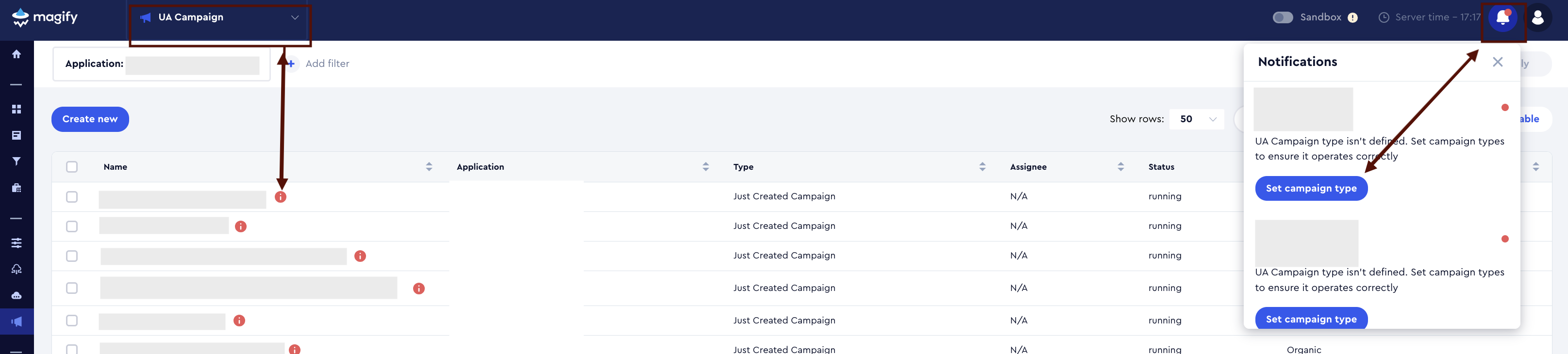
The notification remains visible as long as at least one campaign has no Type assigned.
Once all campaigns have a Type, the notification disappears automatically.
Campaign List Filtering and Table Settings
Filters
The UA Campaign list can be filtered by:
- Application
- Type
- Media Source
Filters help quickly locate incorrectly configured or unclassified campaigns.
Edit Table
Using Edit table, you can customize which columns are displayed in the campaign list.
Available columns:
- Name
- Application
- Type
- Status
- Ad Network
Selected columns are saved per user and help adapt the table to different workflows.
Campaigns Imported from MMPs
The system may receive the following campaign types from MMPs:
- user acquisition campaigns;
- cross-promo campaigns;
- search campaigns (may appear as organic depending on MMP logic).
Campaign Type in UA Campaign reflects the acquisition model, not the marketing naming used in the MMP.
Best Practices
- Assign Campaign Type immediately after import.
- For AppsFlyer campaigns, always verify and set Media Source and Type manually.
- Do not edit MMP-imported fields if they are locked.
- Use filters and table settings to monitor campaign configuration.
- Archive campaigns only when they are truly finished.
Summary
UA Campaign is a core configuration section for user acquisition analytics.
Correctly configured campaigns ensure:
- clean and consistent analytics;
- correct source and network attribution;
- reliable data across all analytical reports.
Misconfigured campaigns directly impact data quality and should be corrected as early as possible.